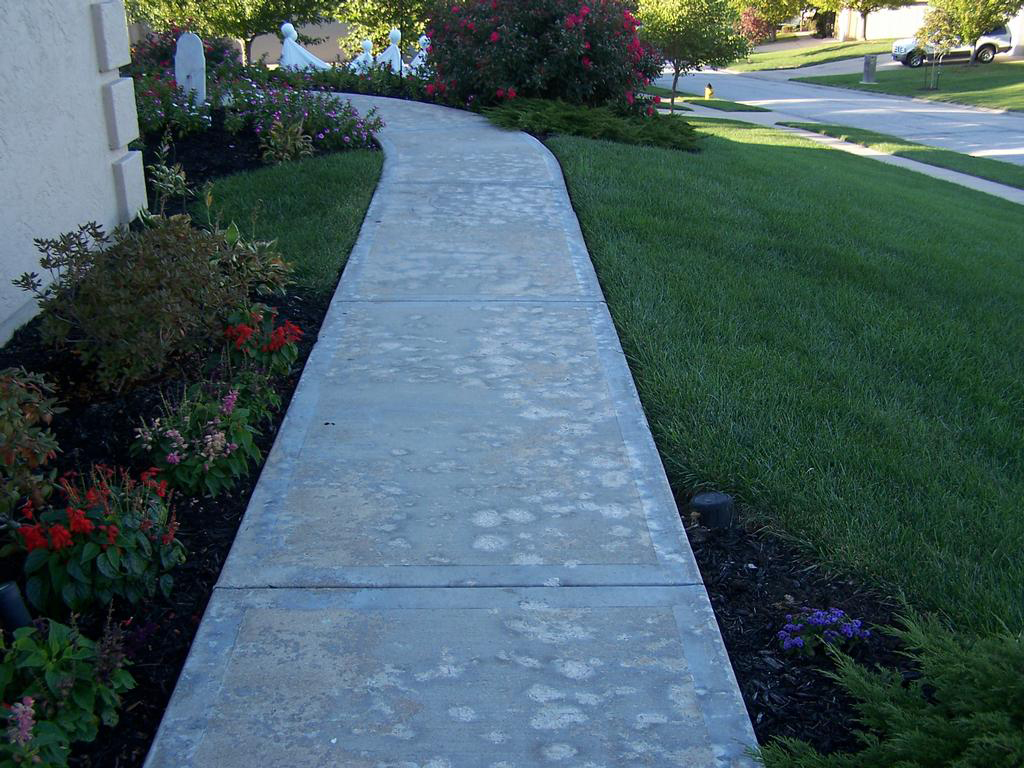
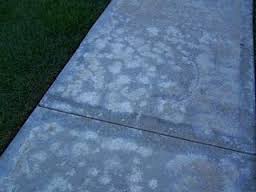
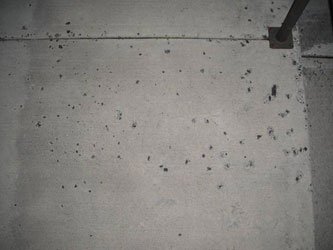
Use the arrows—or swipe on mobile—to view examples of winter-related concrete damage.
Harsh winters throughout Southwest Michigan and Northern Indiana can be extremely hard on existing concrete. Snow, ice, freezing temperatures and repeated temperature changes all place stress on concrete driveways, sidewalks, patios, porches and steps.
The damage is not normally caused by one cold day. It develops as moisture repeatedly enters the concrete, freezes, expands and then thaws. When this process happens over and over throughout the winter, it can gradually weaken the concrete surface.
Concrete naturally contains small pores that can absorb moisture. When the temperature falls below freezing, water trapped within those pores can freeze and expand. The expansion creates pressure inside the concrete.
As temperatures rise, the ice thaws and the pressure is temporarily released. Repeated freeze-and-thaw cycles can eventually contribute to surface scaling, pitting, cracking and small pieces of concrete breaking away.
No commonly used deicing salt should be considered harmless to concrete. Sodium chloride, calcium chloride, magnesium chloride and salt-rich road brine can all contribute to concrete scaling and deterioration, although some products and exposure conditions are more aggressive than others. Road brine is a major factor because tires and vehicle bodies carry it from treated roads onto residential driveways and garage entrances.
Salt solutions can keep concrete wet and increase the number and severity of damaging freeze-and-thaw cycles. Even properly sealed concrete can be affected when exposure is frequent and severe. Whenever practical, remove salty slush instead of applying more deicer, and avoid using deicing salt directly on the concrete.
Scaling is often more noticeable where vehicles are parked, especially when they regularly stop in the same locations. Salt-laden snow, slush and road brine repeatedly drip from the tires, wheel wells and undercarriage onto concentrated areas of the slab. Those recurring wet, salty spots can remain saturated longer and endure repeated freeze-and-thaw exposure.
Yes. Sealing is an important and necessary maintenance step for protecting exterior concrete before winter. A compatible, high-performance concrete sealer reduces the amount of water, road brine and deicing solution that can penetrate the surface. This protection helps reduce saturation and the damage caused when trapped moisture repeatedly freezes and thaws. Sealing does not make concrete indestructible, but it is one of the most important preventive measures property owners can take before winter in Southwest Michigan and Northern Indiana.
For proper application and curing, both the outside air temperature and the concrete surface temperature must be between 65°F and 85°F and must remain within that range for 24 to 48 hours while the sealer cures. Choose a dry period with no rain, heavy fog, frost or freezing weather expected, and keep foot and vehicle traffic off the surface during the required cure time. Applying sealer when the concrete is too cold, too hot or damp can interfere with curing and may produce a weak, cloudy or uneven finish.
Exterior concrete needs the protection of a properly maintained sealer, but that does not necessarily mean applying another coat every fall. The resealing schedule depends on the existing sealer, concrete condition, traffic, winter exposure and the product originally used. Applying another coat before the previous sealer has worn sufficiently can cause whitening, bubbling, peeling or an overly slick surface. Confirm that the new product is compatible with the existing sealer and test a small area before treating the entire driveway.
Marc Todd Concrete recommends thoroughly power washing existing exterior concrete before sealing. Power washing removes embedded dirt, road residue, loose material and other contaminants that can interfere with adhesion or penetration. Oil and stubborn stains may require additional treatment. After cleaning, allow the concrete to dry completely for the period required by the selected sealer manufacturer before applying the product.
Cracks, scaling, settlement and other deterioration should be evaluated before sealing because sealer is not a structural repair and will not correct an unstable base or damaged concrete.
Use a high-performance sealer intended for exterior concrete and compatible with the existing surface and any previous sealer. Local ready-mix plants and professional concrete-material suppliers are good sources for commercial-grade products and product-specific guidance. The correct choice may differ for plain broom-finished concrete, colored concrete and decorative or stamped concrete.
Many exterior concrete sealers can be applied with a product-compatible pump or garden sprayer or with a suitable roller. Rolling, or backrolling after spraying when permitted by the product instructions, can provide more controlled and even coverage. Use only application equipment recommended for the selected sealer, apply thin uniform coats and avoid puddles or heavy buildup.
Control joints are more susceptible to winter damage because their recessed shape collects runoff that can pool instead of draining away. When that runoff includes road brine, the joint also holds a higher concentration of deicing salt. Moisture and salt can remain in the joint after the open slab has begun to dry, and additional residue can build up with every exposure.
This combination of trapped moisture and concentrated deicing salt can increase saturation at the exposed joint edges. As the water repeatedly freezes, expands and thaws, those edges can become especially susceptible to scaling, chipping and gradual deterioration. Before winter, remove leaves, soil and other debris from the joints, check for areas where salty runoff continually pools, and include the joint edges when inspecting the driveway for damage.
If a driveway already has widespread cracking, severe scaling, movement or settlement, sealing alone will not solve the underlying problem. Learn more about concrete driveway installation or contact Marc Todd Concrete to discuss the condition of an existing driveway and possible next steps.
After the snow and ice have cleared, inspect your exterior concrete for changes that may have developed or become worse during winter. Common warning signs include:
Yes. Many areas of scaling, pitting, spalling and other surface damage can be repaired with a high-quality concrete patching compound or resurfacing product. Proper surface preparation is essential. All loose, flaking, weak and unsound concrete must be completely removed until solid material is reached. The prepared surface must then be cleaned and conditioned as required by the repair-product manufacturer so the new material can form a strong bond.
After the patching or resurfacing material has cured for the period specified by its manufacturer, the repaired concrete needs to be protected with a compatible high-quality sealer. Sealing helps limit water and deicing-salt penetration and protects both the repair and the surrounding concrete from continued winter exposure.
The original cause of the damage must also be evaluated. If the slab has serious movement, settlement, widespread structural cracking or a failed base, surface repair alone may not correct the underlying problem and removal and replacement may be the more reliable long-term solution.
Marc Todd Concrete does not hard-trowel exterior concrete exposed to Michigan and Indiana freeze-and-thaw weather. Hard troweling or overworking an exterior surface—especially while bleed water is present—can create a dense but vulnerable surface layer and reduce the effectiveness of air entrainment near the top. A properly timed exterior finish is intended to preserve durability against moisture, freezing and deicing-salt exposure.
Exterior concrete exposed to freezing, thawing and deicing chemicals typically requires a target air content of approximately 5% to 8%, with the exact specification depending on aggregate size, mix design and exposure. Proper air entrainment creates billions of microscopic air chambers throughout the concrete. These tiny relief spaces give freezing water room to expand and help reduce destructive internal pressure.
Marc Todd Concrete uses water-reducing admixtures to achieve needed workability without adding unnecessary water. When specified for a project, an integral water-repellent admixture such as Impede® IntraSeal®, or an equivalent high-performance product, can also help reduce water absorption and the penetration of moisture and deicing salts.
IntraSeal is an added layer of protection; it does not replace the right air content, a controlled water-to-cement ratio, proper finishing, curing or ongoing maintenance. Even concrete made with IntraSeal should still receive a compatible high-performance topical sealer after it has cured for at least 30 days. That topical sealing step is necessary to protect the exposed surface before winter. Apply it only when both the air and concrete temperatures can remain between 65°F and 85°F for the entire 24- to 48-hour cure. Always follow the sealer and admixture manufacturers' current instructions for surface preparation and compatibility.
Long-lasting exterior concrete begins before the concrete is poured. Proper excavation, drainage, base preparation, concrete mix, reinforcement, slab thickness, finishing and control-joint placement all contribute to the performance of the finished project.
Good drainage is especially important. Water should be directed away from the concrete whenever possible so it does not continually collect beneath or on top of the slab and then freeze.
Marc Todd Concrete brings over 35 years of experience to concrete driveways, patios, sidewalks, porches and other residential concrete projects throughout Southwest Michigan and Northern Indiana.